Machine Learning as a Tool to Predict Lithium in Brines: An Example from the Smackover Formation of Southern Arkansas
Presented by: Katherine Knierim, PhD, PG
In-Person
Where: The Petroleum Club of Shreveport, 15th floor
Member Cost: $25 • Non-Member Cost: $35
SGS now accepts Tap Pay via Zelle for meeting payments!
If you’d like a seat, kindly use the form below to make your reservation by the preceding Friday.
We encourage members to invite guests, spouses, and friends to any of our meetings.
Virtual
Via Zoom
Member Cost: $10 • Non-Member Cost $15
**After checkout, you will receive an email with the Zoom Meeting details. You may sign up anytime before the meeting begins.

Biography
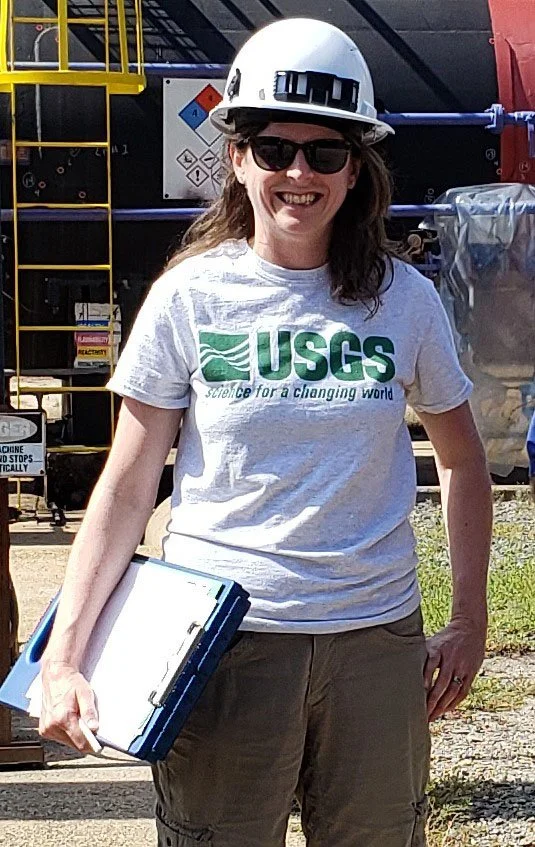
Katherine (Kathy) Knierim is a hydrologist with the U.S. Geological Survey at the Lower Mississippi–Gulf Water Science Center in Little Rock, Arkansas. Her research focuses on groundwater quality, and throughout her career she has worked on a wide range of projects while maintaining a strong emphasis on groundwater studies.
Kathy contributed to the Ozark Plateaus Groundwater Availability Project, which developed a groundwater flow model of the Ozark Plateaus Regional Aquifer System. She also served as a team member and lead modeler for a National Water Quality Assessment Project that used machine learning to predict groundwater quality in the Mississippi Embayment Regional Aquifer System. In addition, she led the Mississippi Alluvial Plain Project water quality task, which collected groundwater age tracers to characterize the age and recharge rates of one of the nation’s most heavily pumped groundwater aquifers.
She is currently a team member on a national groundwater quality project focused on predicting salinity using machine learning. Kathy is also working collaboratively with the Geology, Energy & Minerals Science Center to characterize lithium in the Smackover Formation, and she works with local and state partners to help leverage U.S. Geological Survey expertise to answer questions about water quality and availability.
Kathy has served as a hydrologist with the U.S. Geological Survey since 2015. She earned her Ph.D. in Environmental Dynamics and her M.S. in Geology from the University of Arkansas, and her B.S. with University Honors in Geology from Bowling Green State University. She is also a member of the Geological Society of America, Hydrogeology Division.
Abstract
The chemical composition of high salinity groundwater, or brine, is important to understand for quantifying the availability of both water and critical mineral resources. For example, brines may have high concentrations of dissolved critical minerals, such as lithium (Li), and provide an important economic resource as the world transitions to a greater reliance on Li-ion batteries. The Smackover Formation is part of a regionally important petroleum and brine system in the Gulf Coast region of the southern United States (U.S.) and includes high Li concentrations (> 400 mg/L) in the brines.
In this study, the U.S. Geological Survey and the Arkansas Department of Energy and Environment—Office of the State Geologist used published and newly (2022) collected brine Li concentration data to train a random-forest (RF) machine-learning model using geologic, geochemical, and temperature explanatory variables. Predicted brine Li concentrations from the RF model at approximately 1,000 to 3,000 meters depth across the Smackover Formation ranged from 3 to 420 mg/L. Uncertainty in the mapped RF model predictions—based on the 90th percentile prediction interval across the Li map—were used with formation thickness and porosity information to calculate the range of the Li mass in Smackover Formation brines. This study provides an example of using machine learning to predict deep brine chemistry for a critical mineral resource evaluation.