Declining Haynesville Region and the New Western Haynesville Play
Presented by: William D. DeMis & Kevin B. Hill
In-Person
Where: The Petroleum Club of Shreveport, 15th floor
Member Cost: $25 • Non-Member Cost: $35
SGS now accepts Tap Pay via Zelle for meeting payments!
If you’d like a seat, kindly use the form below to make your reservation by the preceding Friday.
We encourage members to invite guests, spouses, and friends to any of our meetings.
Virtual
Via Zoom
Member Cost: $10 • Non-Member Cost $15
**After checkout, you will receive an email with the Zoom Meeting details. You may sign up anytime before the meeting begins.


William D. Demis
William DeMis runs an oil-and-gas consultancy. He is an angel investor in a major domestic start-up company that aspires to drill some very important wildcats in the gulf coast.

Kevin B. Hill
Kevin Hill is a geoscience consultant with over 49 years of experience in oil-and-gas exploration and development, salt imaging, solution mining and just about anything you might want to know about under your feet.
Biographies
William DeMis runs an oil-and-gas consultancy. He is an angel investor in a major domestic start-up company that aspires to drill some very important wildcats in the gulf coast. Bill likes to look at outside prospects, but he also likes to generate his own prospects for fun and, rarely, for profit.
Mr. DeMis has been employed as a word-a-day prospecting geologist for most of his 35 years, but he has also held important-sounding titles including: Exploration Manager at Marathon Oil, Exploration Vice President at Roxanna Oil, and Senior Vice President and Chief Geologist at Goldman Sachs.
Bill has received two Best Paper Awards from the AAPG for his analysis of the effects of US dollar exchange-rate variations on the value of oil on global markets. He has also won also “best paper” awards from Rocky Mountain Associations of Geologists and from the GCAGS when it was hosted in Shreveport.
_____________
Kevin Hill is a geoscience consultant with over 49 years of experience in oil-and-gas exploration and development, salt imaging, solution mining and just about anything you might want to know about under your feet.
He has received a Best Paper Award from the AAPG and published numerous papers on different subjects dealing with many aspects of seismic, solution mining and field studies.
Kevin is currently president of the Shreveport Geological Society.
Abstract
Natural gas will be short in supply in the Gulf Coast in four years. An accounting of the additions into, and subtractions out of, the US Gulf Coast shows there will be a shortfall of 11.5 BCFG/day by 2029. This shortfall will force prices up.
Gas pipelines will bring 7 BCFG per day of Permian gas into the Gulf Coast by 2029. LNG exports out of the Gulf Coast will increase by another 11 BCFG per day. Large data centers might add 1 BCFG per day in demand. Planned additions of liquified natural gas exports out of the Gulf Coast are 13 BCFG/day. In addition, the Haynesville Region might decline another 6 BCFG per day.
Haynesville Region dominates Gulf Coast gas supply. The entire Haynesville Region is in decline, as shown by IEA data. Gas production for the Haynesville Region has slid below 15 BCFG/day and continues to decline. Haynesville field proper (the area over the Sabine uplift) has declined by 1 BCFG/day since 2023. The field might have reached its “geologic limit.”
The Barnette and Fayetteville shale plays provide useful analogues in predicting the coming decline in Haynesville Region. Shale gas plays decline very quickly once plays reach their “geologic limit.” Using the Barnette and Fayetteville plays as analogues, the Haynesville Region might decline by another 6 BCFG/day by 2028.
All the leases in Haynesville field are held by production. Operators will now make preserving shareholders’ value a priority. They have no incentive to “drill baby drill” (over-drilling in Haynesville field drove down natural gas prices in 2023). Several major operators of the Haynesville field have said they will be reluctant to stand up rigs until the prices are above $3.50. So, either by “geologic limit” or by operator discretion, there will be less Haynesville gas to depress prices going forward.
The western Haynesville field is an ultra-deep play with horizontal wells landing at 17,000 to 19,000’ TVD. Western Haynesville wells have impressive Initial Potentials of 30 to 40 MMCFG per day. Estimated Ultimate Recoveries are circa 32 BCFG per well. Wells that have been producing for 20 months have produced 12 BCFG and are still producing 13 MMCFG per day. This rate is 2.5 times the rate of a “classic” Haynesville field well at 20 months! Natural gas production from the Western Haynesville play might reach 1.5 BCFG/day by 2030.
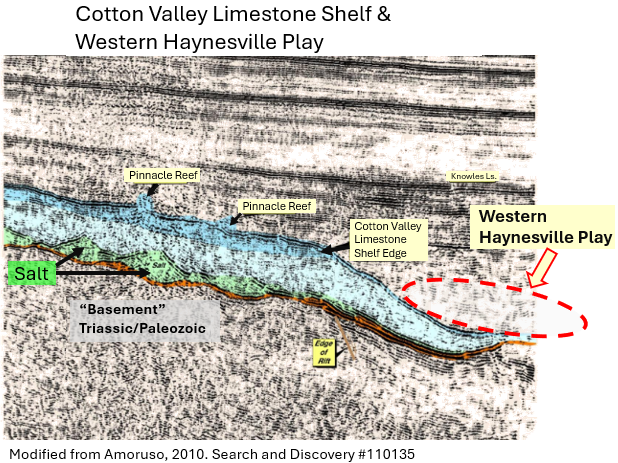
Seismic shows the Western Haynesville wells are drilled in Haynesville-Bossier strata that dips steeply into the East Texas basin. The strata are cut by normal faults. Some syn-depositional growth can be seen on seismic along the play. The sweet spots of the play seem to be basin-ward of the Cotton Valley shelf edge, down-dip of areas where siliciclastic input is possible. Slope and basin-floor thin (<1 foot) turbidite sands might be contributing to the excellent flow rates and shallower declines in Western Haynesville field vs Haynesville field.
The play is currently very narrow in map view. However, Expand Energy wildcat outpost in Houston County suggests the play might be broad. The Bobby Yancey has an 8,000’ lateral at 17.300’ TVD. The well is rumored to have an Initial Potential 50 MMCFG per day.
It is unlikely the Western Haynesville play will replace the coming shortfall in natural gas volumes, but doubtless more discoveries will be made in the Western Haynesville trend.